Junglebee
How to Start a Surf Tour Business in Montego Bay
A practical operator guide to selling surf days you can actually deliver, from weather calls and pickups to clean booking handoffs.
 Michael RouveureFounder, Junglebee ·
The message came in while I was running SXM Deals: a guest wanted to make a big booking, and I needed the operator to confirm before I took the money. I sent the message. Then I waited.
Two days. Not two minutes. Two days.
By the time the operator got back to me, the guest had moved on. I lost the booking, and the operator lost it too. Nobody was trying to be difficult. He was out working the boats, then cleaning up, then trying to eat and sleep. But the booking system had made a simple question impossible to answer quickly.
I think about that whenever someone asks me how to start a surf tour business in Montego Bay. The surf, the boards, and the photos matter. But your first business problem is not finding the perfect wave. It is building a day that you can actually sell, confirm, and deliver when you are tired and the weather changes.
Start with the kind of surf day you can repeat
Do not offer every kind of surf experience. Decide what your operation can do well with the people and equipment you have.
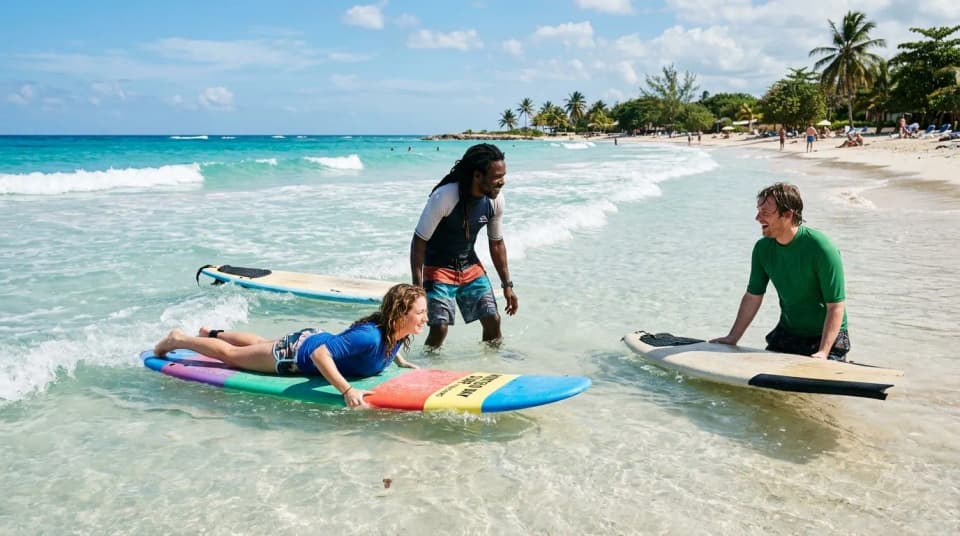
Maybe you are teaching a first lesson near the Hip Strip, running a guided outing for experienced guests, or combining a lesson with a beach and food stop. Those are different products, even if they all contain a surfboard.
I would write down the actual shape of the day:
- Guest level: first-time, beginner, intermediate, or mixed.
- Group size: the number you can supervise without making the water feel crowded.
- Timing: when conditions, transport, and guest energy usually line up.
- Included gear: boards, leashes, flotation equipment, water, and anything else you promise.
Keep the first version narrow. A repeatable two-hour lesson is a better foundation than a six-hour adventure that falls apart when one pickup runs late.
Build the weather decision into the product
Surf operators do not control the ocean. That sounds obvious, but a lot of booking pages are written as if the sea is a meeting room that stays available because you put it on a calendar.
Decide in advance what happens when conditions are not right for the guest you sold. Who checks the conditions? How close to the start time do you make the call? Do you move the lesson, change the location, offer a different activity, or refund it? What does the guest receive by text or email?
Write this in plain language before you take your first booking. Do not hide it in a policy page nobody reads. A guest who understands the weather call is usually easier to help than a guest who discovers the rules after packing a bag.
Leave room in the schedule. If every minute is sold, one late pickup or slower beginner can push the day into trouble. Empty space is where the operation absorbs real life.
Make the pickup and handoff boring
The most memorable part of the surf tour should be the water, not a frantic phone call asking where the guest is staying.
Set one place for each pickup area. Ask for the hotel name, meeting point, phone number, and the best way to reach the guest. Send the meeting details more than once. If a driver, instructor, and shop owner are involved, make sure all three people see the same booking information.
This is where small businesses lose time. The booking is confirmed, but the useful details are scattered across Instagram messages, a paper notebook, and somebody's personal phone. Then the guest arrives and the instructor does not know whether they booked a lesson or a guided session.
When I was working through SXM Deals, hotel activity desks had their own version of this problem. A guest might arrive with a little piece of paper and a number on it, and the operator had to work out which hotel sent them, what they paid for, and where they were supposed to go. It was a massive mess for something that should have been a clean handoff.
Sell the details guests are actually worried about
A surf tour page needs good pictures, but pictures are not enough. A first-time guest is quietly asking a much longer list of questions.
- Will somebody show me what to do, or am I expected to know already?
- What should I bring, and what is provided?
- How hard is the walk from pickup to the water?
- What happens if I am nervous, late, or the weather changes?
- Is this suitable for the children or older travelers in my group?
Answer those questions on the booking page. Put the important details beside the book button, where the guest is making the decision.
I also like a short confirmation message that repeats the meeting point, start time, what to bring, and the weather policy. That message does more work than another gallery image. It gives the guest something they can show to a partner, a hotel desk, or a taxi driver.

Keep bookings moving when you are on the water
You will be busy when people want to book. That is the whole point. A guest may be looking at your surf tour from a hotel room while you are carrying boards, teaching a lesson, or driving back from the beach.
Do not build a business that depends on answering every availability question by hand. Your calendar should show what is available, collect the details you need, and send a confirmation without waiting for you to come off the water. If you need to check conditions first, make that a clear step rather than an invisible delay.
We built Junglebee around that kind of handoff: the guest, the operator, and whoever took the booking should be looking at the same information. That does not make the ocean predictable. It does stop a simple booking from getting lost in somebody's inbox.
And if you take card payments, decide where the money settles and how you will reconcile it before launch. Your bookkeeping should not require a detective story at the end of the month.
The first version should be easier to run than to explain
Before you spend heavily on branding, run a small test. Put one surf product on sale, with one clear meeting process, one weather decision, and a schedule you can deliver without rushing.
After each trip, ask yourself:
- Where did the guest need more information?
- Which handoff depended on a phone call?
- What part of the schedule left no room to recover?
- What did the instructor have to remember that the booking should have captured?
Fix those things before adding another tour or another pickup area. A surf business grows from clean days repeated, not from a crowded menu that nobody can operate calmly.
That old SXM Deals booking still bothers me because the answer should have taken two minutes. If you are starting a surf tour in Montego Bay, build your operation so the guest gets an answer while you are doing the work you came to do. The water can be wild. Your booking process does not have to be.
Booking page, card payments, one calendar for your website, booking page and desk. 4% per card payment, no monthly fee.