Junglebee
Snorkeling Gear: What a Snorkel Boat Captain Would Pack
A snorkel boat captain on what snorkeling gear to bring, what to borrow from the boat, reef-safe sunscreen rules and full-face mask risks.
 Michael RouveureFounder, Junglebee ·
- Bring your own mask and borrow fins, snorkel and vest from the boat; a mask that passes the strapless seal test matters more than anything else you pack.
- Choose mineral sunscreen with only zinc oxide or titanium dioxide, then check local laws and marine park rules; these destinations do not all have the same restrictions.
- Full-face masks showed CO2 rebreathing in lab tests. Never use OUSPT masks covered by the CPSC warning; ask the crew before bringing other full-face models.
"Should I bring my own snorkeling gear?" Guests ask it at the dock all the time, and most of them are carrying more than they need.
I grew up working on my parents' boats at Eagle Tours in St. Maarten. I started as a deckhand, moved up to first mate and then captain, taking cruise ship and hotel guests out to beaches, reefs and the neighboring islands. Handing out masks is part of a snorkel crew's day, and leaks come up first. My answer is short: bring your own mask and borrow everything else from the boat.
Your snorkeling gear starts with the mask
Fins and snorkels are forgiving. A mask isn't. If it leaks or fogs, you spend the whole stop lifting your head to clear it, so a mask that fits your face is the one piece worth owning.
The seal test takes ten seconds in the shop:
- Skip the strap. Hold the mask to your face with no strap on.
- Inhale gently through your nose. Then let go.
- Watch it. If it stays put, it may seal, so check the fit with the snorkel mouthpiece in. If it drops, try another shape.
Move hair out from under the skirt first; a mustache can break the seal too.
Fogging is the other complaint. New masks usually carry a thin factory film inside the lens, and anti-fog won't stick until it's gone. On plain tempered glass, non-gel, non-whitening toothpaste rubbed in and rinsed well does the job. For coated or tinted lenses, follow the maker's instructions. After that, a drop of defog or baby shampoo on the dry lens, lightly rinsed, keeps it clear.
Borrow the rest: snorkel, fins and vest
A basic snorkel is an open tube, often with a purge valve to blow out water. A dry-top adds a float valve that closes when the tip goes under. For a first-timer in a little chop, that means fewer mouthfuls of seawater. Breathing resistance varies by model, and the trapped air fights you if you like to duck-dive.
Fins come in two styles:
- Full-foot fins slip on barefoot like a shoe and are the norm in warm water.
- Open-heel fins have an adjustable strap. Some go on barefoot; others need booties, which also protect your feet on rocky entries.
Off a swim platform, full-foot fins are plenty. Ask the boat which sizes it carries.
Snorkeling gear for kids is where fit matters most. Buy a child-sized mask and run the seal test at home. Get a snorkel sized for the child too, not just a smaller mouthpiece on an adult tube.
Ask for a snorkel vest even if you swim well. On a snorkel boat you see strong swimmers tire on a longer reef swim, and a vest lets you rest face-down. A snorkel vest is a swim aid, though, not an approved life jacket, and it may not turn you face-up. For a child who can't swim, ask the crew whether the trip suits them, and use a properly fitted approved life jacket with an adult close by.
A rash guard is the one thing I'd tell every guest to pack. Get a UPF-rated one for your back, and put sunscreen on the rest.
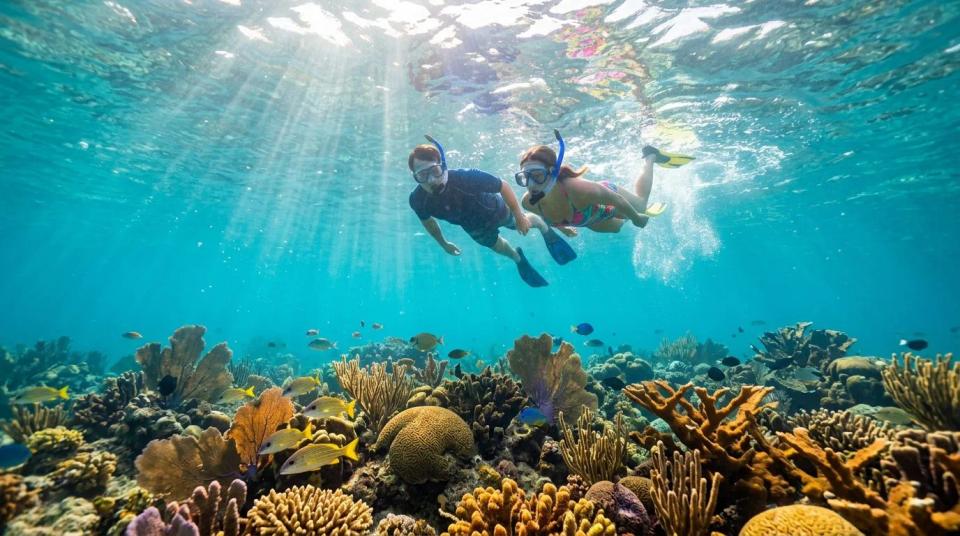
Reef-safe sunscreen: where it is the law
More places than you'd think regulate sunscreen, so check before you pack:
- Hawaii: Since January 1, 2021, state law has banned the sale of sunscreen containing oxybenzone or octinoxate without a prescription.
- Maui County: Since October 1, 2022, only mineral sunscreens (zinc oxide or titanium dioxide) can be sold, distributed or used without a prescription.
- Bonaire: STINAPA's marine park beach-use rules call for sunscreen free of oxybenzone and octinoxate.
- US Virgin Islands: The territory bans selling, distributing, using and possessing sunscreens containing oxybenzone, octinoxate or octocrylene, with a prescription exception for products supplied through a licensed pharmacy or drug store.
- Aruba: Since July 1, 2020, the import, manufacture and sale of sunscreen containing oxybenzone has been banned.
For these places, pick a mineral sunscreen with only zinc oxide or titanium dioxide, and check current local rules.
The full-face mask question
Full-face masks look easy, but the worry is carbon dioxide building up when exhaled air gets rebreathed. A 2023 study in Diving and Hyperbaric Medicine tested two full-face models against a conventional snorkel and found signs of rebreathing in every full-face wearer. Those runs were also stopped for high CO2 more often. The test was on dry land, not in the ocean.
After a run of drownings, Hawaii's Department of Health commissioned a snorkel safety study. A 2022 paper identified rapid onset pulmonary edema as a possible drowning mechanism and high breathing resistance as a potential contributor, though the researchers could not establish how often it caused deaths or whether full-face masks added risk. In March 2026, the US Consumer Product Safety Commission told consumers to stop using one specific brand, OUSPT, citing labored breathing and increased CO2.
Not every full-face mask is dangerous, but on a boat trip I'd stick with a regular mask and snorkel. Some operators don't allow full-face masks at all, so ask before bringing one. If yours is an OUSPT mask covered by the CPSC warning, stop using it and dispose of it; don't sell it or give it away.
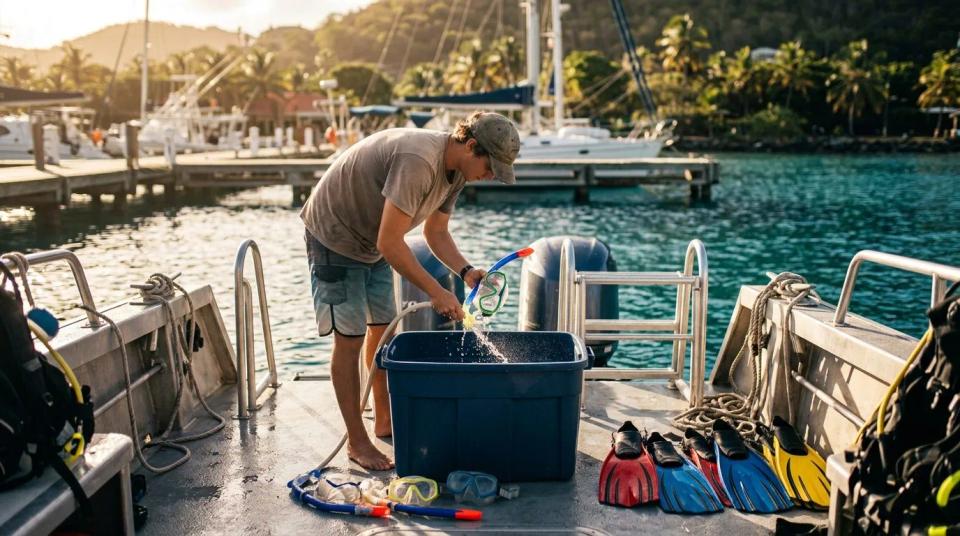
What to stock, and when to retire it
If you run the boat, keep this on board:
- Masks in several shapes, kids' sizes included.
- Full-foot fins in every size, with spares in the common adult ones.
- Snorkel vests for adults and kids, on top of your required life jackets.
- Defog and spare straps within reach, because a mask that fogs or loses its strap ends someone's stop early.
Between groups, the Divers Alert Network says a freshwater rinse alone won't kill germs on gear that touches the eyes, nose or mouth. Pick a disinfectant that's suitable for dive gear and follow the label on dilution, contact time, rinsing and drying. Keep clean gear away from the dirty rinse bin.
In Caribbean humidity, let everything dry fully in a ventilated space or mold will win.
Retire a mask when the skirt tears or stops sealing, because a leaking mask is the one guests complain about. Check snorkel valves and fin straps too. Stop using gear with damage or parts that don't work.
Bring the mask, borrow the rest
Guest or operator, the answer holds: bring a mask that fits your face and let the boat handle the rest. I run Junglebee now, the booking system we built for operators like you, but I learned that part on deck.
Booking page, card payments, one calendar for your website, booking page and desk. 4% per card payment, no monthly fee.