Junglebee
Boat Rental App vs Booking Software: What I Would Actually Compare
A boat operator's practical comparison of guest apps, booking software, shared availability, payments, crew handoffs, and a two-week test.
 Michael RouveureFounder, Junglebee ·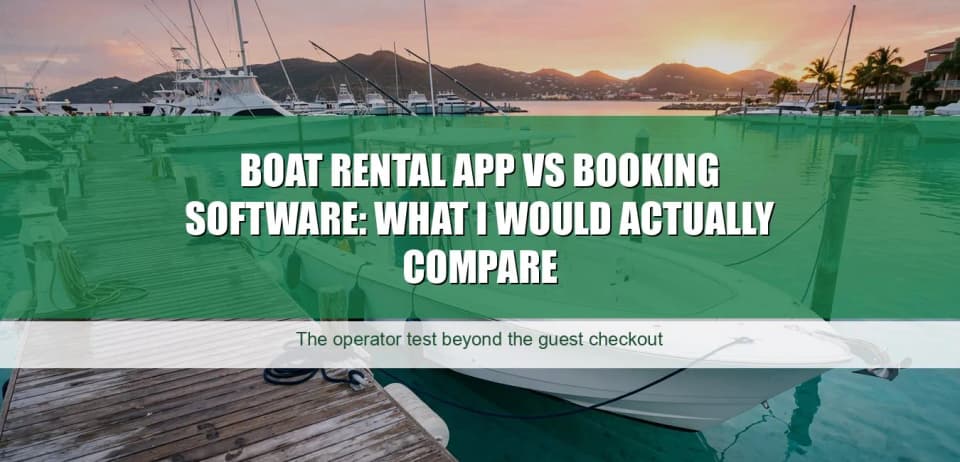
Boat Rental App vs Booking Software: What I Would Actually Compare
Most boat rental apps solve the guest's problem. They let someone look at a boat, pick a time, and tap a button.
That is useful. It is not the whole business.
The hard part starts after the booking comes in. Who knows about it? Has the deposit arrived? Is the boat free, or did somebody promise it to a hotel desk over the phone? What happens when the wind comes up and you need to move six guests to tomorrow morning?
I grew up working on boats in St. Maarten, first as a deckhand, then as a first mate, and eventually as a captain. So I am asking whether the tool can keep the boat, office, crew, and guest looking at the same day.
The guest-facing app is only one piece
A boat rental app is usually judged by what the guest sees. Is the page clear on a phone? Can the guest see the trip time and price? Can they pay without calling the office?
Those questions matter. But a clean checkout does not tell you whether the rest of the operation is under control.
For a small boat business, I would also want to see:
- Availability: Does a booking remove the right boat and time from every place where you sell?
- Guest details: Can the crew see names, phone numbers, passenger counts, and notes without hunting through email?
- Money: Is the deposit or full payment tied to the reservation, not sitting in a separate spreadsheet?
- Changes: Can you move a trip, change the passenger count, or record a balance without starting over?
If the app handles the first tap but leaves you doing the other work by hand, you have bought a storefront. You have not fixed your booking operation.
What I learned from waiting two days for an answer
When I was running SXM Deals, a guest wanted to make a large booking. I did not want to accept the payment before the tour operator confirmed that the trip was available. So I sent the operator a message.
Then I waited.
It took something like two days to get an answer. I should have had it in two minutes. Not two days. I lost money, and the guest was left waiting while I tried to get a simple yes or no.
I do not blame the operator. A lot of these businesses are one-man operations. The owner runs the boat, comes back, cleans it, and finally looks at the phone. By then the request is buried.
That is the difference between a boat rental app and a real booking system to me. The app takes the request. The system needs to make sure the right people can see and act on it before the request turns into a problem.

Shared availability beats a prettier calendar
Boat rentals get sold in more places than the main website. You might have a phone number on Google, an activity desk at a hotel, a partner on the marina, a social media message, and a captain who takes a booking while standing on the dock.
That is where calendars get into trouble. A calendar that looks nice but only knows about one sales channel is not giving you availability. It is giving you one version of availability.
I would test any boat rental app with the awkward cases, not the perfect demo:
- Book the same boat through two different routes and see how quickly the second route knows it is gone.
- Place a temporary hold, then release it and check whether the time comes back correctly.
- Move a trip to another day and see what the guest, crew, and office each receive.
- Add a private charter beside a regular tour and check whether the system understands the difference.
If the answer is, "The office manager has to update that manually," keep asking questions. Manual work is not automatically bad. Hidden manual work is the part that hurts you on a busy cruise ship day.
Payments are part of the reservation
A payment should not be a separate event that somebody matches to a booking later. That is how names get misspelled, balances get missed, and refunds turn into a late-night search through inboxes.
Ask what the system records when the guest pays a deposit. Ask where the balance due appears. Ask what happens if the guest changes the date or if weather blows out the trip. And ask whether the money can reach the bank account your business actually uses.
That last question matters in the Caribbean. Payment tools built around mainland assumptions do not always fit an island operator's banking reality. I have seen companies create an awkward route through an overseas bank just to accept a card online. I think that is a bad trade: more bookkeeping, more explaining, and more places for money to get stuck.
We built Junglebee's charter booking system around the reservation and payment together because that was the problem I kept seeing. The test is whether the booking still makes sense when you need to move it, refund it, or collect the rest.

The crew should not need a desk to know the plan
A boat rental business has a strange office. Part of it is at a desk, part in the marina, and part on the boat with an unreliable signal and somebody asking where the snorkel gear went.
So I want the crew to have the information they actually need without asking the office to read out a spreadsheet. The trip time. The guest count. The meeting point. Special notes. Whether the booking is paid, partly paid, or still waiting.
This is also where the difference between a rental and a charter shows up. A rental may be a boat and a time. A charter often includes a captain, a route, food or drinks, and a conversation about what the guest thinks they bought. The system has to leave room for those details without turning the crew's morning into paperwork.
A nice customer page cannot compensate for a crew that is working from yesterday's information. I would rather have a plain screen with the correct trip than a beautiful app with stale details.
My two-week test before trusting any app
I would not choose a boat rental app from a demo alone. I would run it through two weeks that include ordinary bookings and at least one annoying change.
During the test, I would watch five things:
- How many times does someone retype a guest's information?
- How long does it take to confirm a booking from a partner or hotel?
- Can the captain see the same trip information as the office?
- Can the team explain the deposit and balance without opening another system?
- When a trip moves, can everyone tell what changed and why?
Do not only ask whether the guest can book. Ask whether your team can finish the day without reconstructing bookings by hand.
That is my real comparison. A boat rental app can help you sell a seat or a boat. Booking software should help you keep the promise after somebody buys it.
Booking page, card payments, one calendar for your website, booking page and desk. 4% per card payment, no monthly fee.