Junglebee
Tour and activity booking software: an operator's guide
An operator's guide to tour and activity booking software: what it really has to do on a busy Saturday, and how to evaluate without checklists.
 Michael RouveureFounder, Junglebee ·
Before any of us had software, the activity desk at a hotel would book a tour by sending the guest down to the dock with a folded piece of paper. A room number, sometimes a name, a scribbled time. The captain would come in off the morning run, salt still drying on his arms, and try to work out which hotel that chit came from, whether the guest had paid, and whether he even had a seat left on the afternoon cat.
I watched operators run their whole business that way for years. One of the most organized companies on our island, a big one, was completely paper-based when I first met them. Binders. Phone calls. A wall of staff fielding it all. They were good at it, which is the strange part. They had simply built a small army to do by hand what a booking system is supposed to do in the background.
So when an operator asks me what tour and activity booking software should do, I don't start with a feature list. I start with a Saturday.
Picture a busy Saturday, then ask what breaks
It's a cruise ship day. You've got a morning snorkel run, an afternoon charter, and a sunset cat. Your phone is going. A hotel desk wants two seats on the 2pm. A guest is paying on your website. Another is paying through Viator at the same second. Your office manager is trying to print a manifest while the captain wants to know who's actually showing up.
That's the test. Not the demo. Not the brochure. A real Saturday with money moving in three directions at once. Most software looks great until that exact moment, and then you find out what it was really built to do.
So before you look at a single vendor, write down your own busy Saturday. The trips, the agents, the payment paths, the day-of chaos. Then make the software prove it can survive that day, because the guests don't care that the dashboard was pretty.
Where these systems usually fall apart
Once you've got your Saturday on paper, you start seeing the same cracks across most of the booking software out there.
- The money goes on a trip you never booked. A lot of systems are built around Stripe or PayPal, and Stripe still is not available for many Caribbean operators; PayPal may be available, but local withdrawal and currency support can vary by island. So some operators end up routing card payments through a foreign account and moving the money home later. That can raise tax and compliance questions, so it is worth getting proper advice before doing it. The software should land your money in your own local bank, full stop.
- Day-of changes turn into a phone tree. Christmas Winds blow out a morning run and suddenly you need to move twelve guests and issue credit, not cash, before they ask for a refund. If that takes three emails per guest, the software is fighting you.
- The manifest won't come out clean. Your captain needs a printable list of who is on which boat, with notes, by a certain time. Sounds basic. Plenty of systems make it a chore.
- Agents and OTAs live in a separate world. Hotel activity desks and the online channels both need to book straight into your availability. When they can't, a person becomes the integration, and that person is usually you.
- The paper chit comes back. If reconciliation at the end of the week still means matching scraps and screenshots to bank deposits, you didn't replace the paper. You just gave it a login.

The three things the software actually has to do
Vendor checklists can run long, and the effect is the same: the demo feels thorough and you feel like you'd be reckless to choose anything with fewer boxes ticked. I'd ignore most of it. Strip the noise away and the software really only has three jobs.
It has to answer when you can't. When you're out on the water for four hours, the booking still gets confirmed, the deposit still gets charged, the seat still gets held or released. The trigger that built our whole company was an operator taking two days to confirm a charter I was holding real money for. Two days. The point of a booking system is that nobody waits two days again.
The money piece is non-negotiable: handle your money where you live. Card payments into your own bank, on your own island, in the currency you actually spend. Not a detour through a continent you've never visited.
It has to tell you the truth at the end of the week. Bookings, card payouts, and reseller sales in one set of reports, so your Sunday isn't a spreadsheet. If a system does those three things well, the other fifty-seven features on the checklist are mostly decoration.
How to evaluate without falling for the checklist
Stop reading comparison sites that rank ten products you'll never use. Pick two systems and actually run them.
Build one real trip in each, with the deposit and the weather policy and the waiver included, then push a week of live bookings through both. Watch three numbers. How many guests finished checkout on their phone. How long a refund took you. And what your Friday-afternoon reconciliation actually cost you in hours.
Then call their support and ask a question only an island operator would ask. Marine park user fees. A force-majeure cancellation with the wind at thirty knots. Agent net rates for a hotel desk. The answer tells you fast whether the people who built it have ever stood on a dock, or whether they sold to people who do and called it close enough. We built Junglebee from the dock side of that line, which is the only reason any of this is obvious to me.
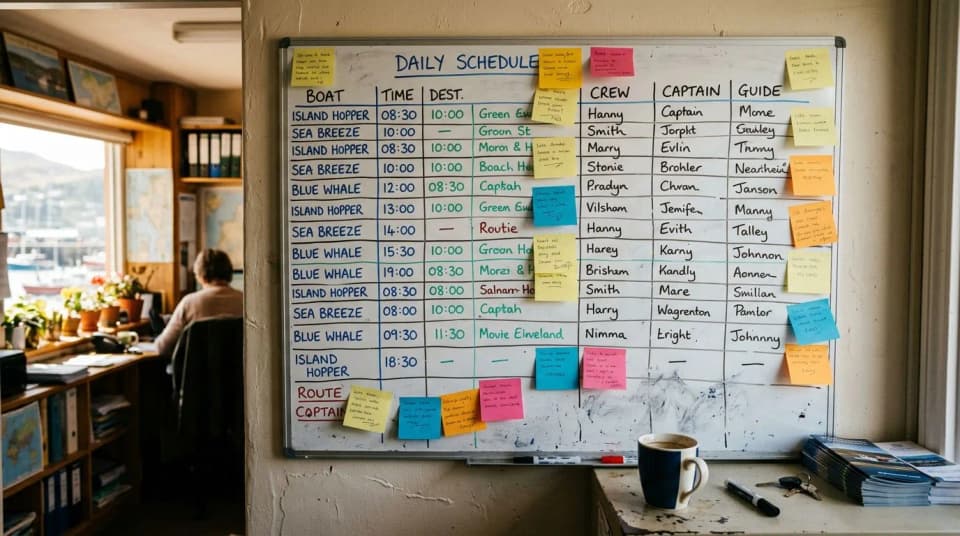
Buy the Saturday, not the feature list
That paper-based company I mentioned at the top eventually digitized everything. The binders went away, the wall of staff got to do real work, and the bookings just fell into the system whether they came from the website, an agent, or a hotel desk. Nothing magic happened. They just stopped doing by hand what the software was supposed to do quietly in the background.
If you remember one thing when you go shopping, make it this. You're not buying features. You're buying a calm busy Saturday. Hand the salesperson your own version of that day and watch how fast the long checklist gets short.
Booking page, card payments, one calendar for your website, booking page and desk. 4% per card payment, no monthly fee.