

April 9, 2026

I've said it before and I'll say it again: jet ski is the only product in the Caribbean where the insurance cost can exceed the cost of the equipment. Not the maintenance. The insurance. A Sea-Doo off the lot runs you maybe $15,000-$18,000. Commercial liability coverage for a two-ski operation in the ABC islands? I've watched operators price it out and come back looking pale.
That's not a reason to skip it. Aruba is a good market - steady trade winds, clear water, tourists who showed up ready to spend. But jet ski is a different animal than a charter boat, and if you walk in thinking "I'll just get some machines and put up a sign," the economics will hit you hard.
My home is St. Maarten. But I've watched operators across the Caribbean build and kill jet ski businesses, and the pattern is consistent enough that I can tell you exactly where they go wrong.
Aruba regulates commercial watersports tightly. A watersports permit is required, and applications for new permits are suspended until further notice. That last part matters enormously.
The Navigation Department - Directie Scheepvaart - handles the licensing. The application goes to the Minister of Transportation. The process isn't just paperwork: your craft gets submitted for physical approval and control. That takes time even when permits are open.
So your actual first move, before you touch equipment or sign anything, is to find out what's realistically available. In practice that often means one of two paths:
Acquisition is genuinely the faster path right now. You get permits in place, maybe some staff who know the beach. Just make sure you're buying the legal entity, not just the machines.
When permits do open - or if you're formalizing an acquisition - Aruba's requirements are specific. Come prepared with:
Write your activities list like a menu and include everything from day one. Walk-up rentals, guided rides, photos, tandems - whatever you might ever sell. Adding it later means a new approval cycle.
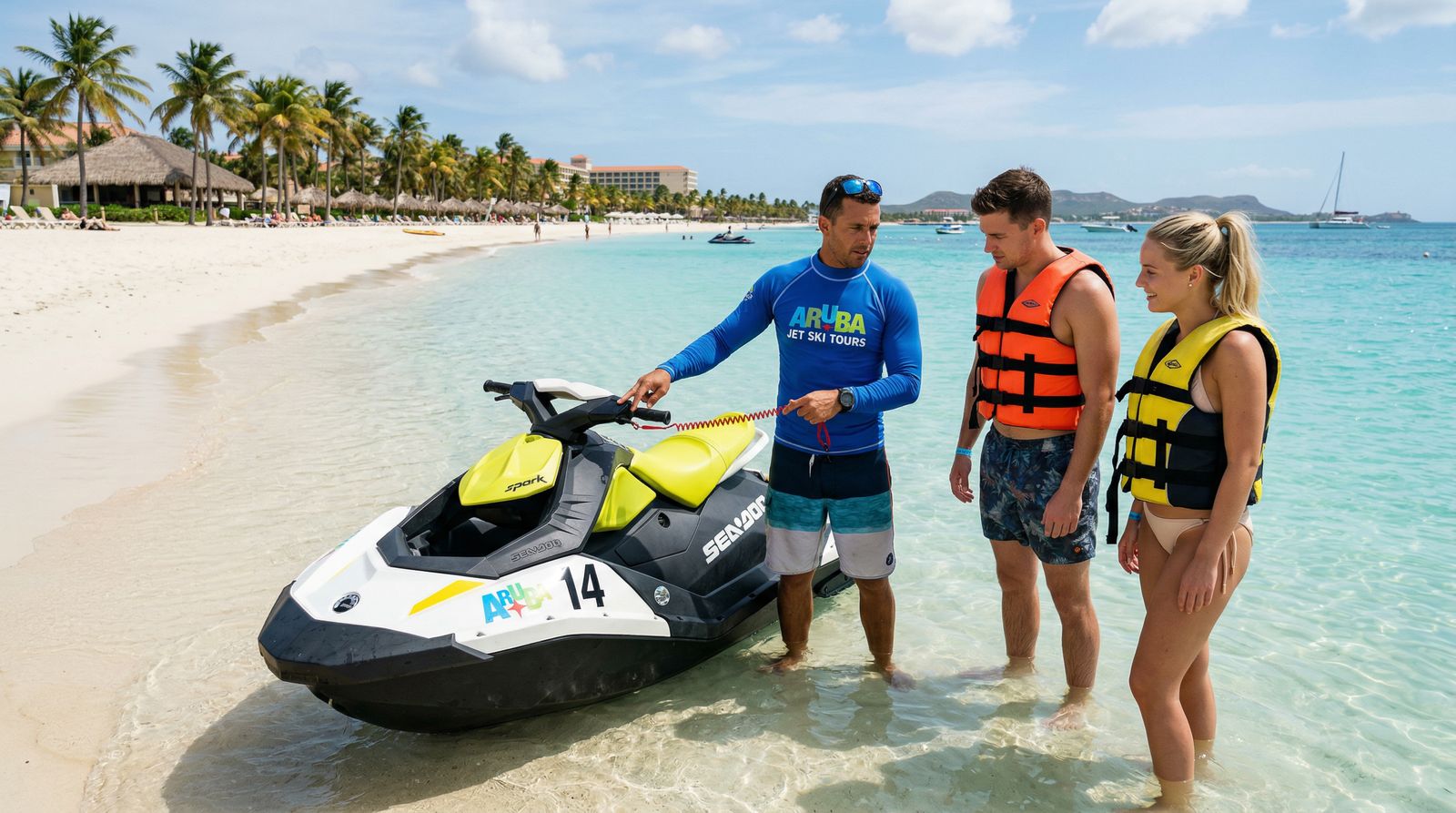
A charter boat carries guests for two to four hours. The skipper is in control. Guests are passengers. On a jet ski, guests are operators - untrained, often overconfident, occasionally drunk. Insurance companies know this, and they price it in accordingly.
I've watched operators underestimate this by a factor of two or three. They budget for the machines and forget the insurance is the real line item. Two or three incidents in a season - even minor ones, no injuries, just a claim - and your next year's premium can wipe your margin entirely.
Jet ski also has one of the highest walk-up cancellation rates of any Caribbean product. Guests cancel for weather, nerves, cold feet. You need a deposit policy that's real, not just a checkbox nobody reads.
Aruba has already moved on propeller guards: commercial boats for water activities must have propeller guards as of January 1, 2025. Even if you're running PWCs rather than inboard boats, the direction is clear. The island is getting stricter, and your operation should be ahead of the regulation, not scrambling to catch up with it.
Build three layers of safety and treat them as non-negotiable:
The operators who last make the briefing feel like part of the product, not a liability waiver being read at them. Guests who feel taken care of at the start ride better and review better at the end.

Jet ski demand is spiky. Rush after breakfast, a midday lull, another wave in the afternoon. If you run walk-up whenever, you'll have guests stacking up at the same time, then machines sitting idle for an hour. Sell time slots. One clear product - a 30-minute or 45-minute session - that your staff can run like clockwork. Add one upgrade for guests who want more. That's the whole menu.
When you're evaluating a beach location, the questions that matter are: who controls the shoreline rights, where is your designated operating zone relative to swimmers and anchored boats, and what does your team say when a guest shows up in rough conditions. That last one needs an answer before your first guest, not during your first argument.
On booking systems: paper is fine until it isn't, and in jet ski the "isn't" moment usually involves a double-booking on a busy Saturday with eight guests in your face. Digital waivers saved to the booking record, automated confirmations, deposits that actually process - that's what keeps a busy operation from becoming a chaotic one. We built Junglebee specifically for Caribbean watersports operators and handle all of that without needing a mainland payment processor.
I've watched jet ski operations fail the same four ways across the Caribbean: no permits, wrong insurance, no deposit policy, no supervision. Every one is a choice made early that felt fine until it didn't.
The operations that last run one good product in one well-managed zone. They're not complicated. They just built the boring parts right before they opened.
Aruba has the tourists and the water. The regulatory framework is strict but at least legible. Jet ski, done right, can run lean and generate real margin. Just go in knowing it's not the easy product. It's the one where the insurance costs as much as the machine.


