Junglebee
Mobile-First Tour Bookings in 2026 (Or Lose Sales)
Mobile booking is normal now. Use this 2026 playbook to fix your tour website, checkout, messaging, and ops so you convert more guests on phones.
 Michael RouveureFounder, Junglebee · · updated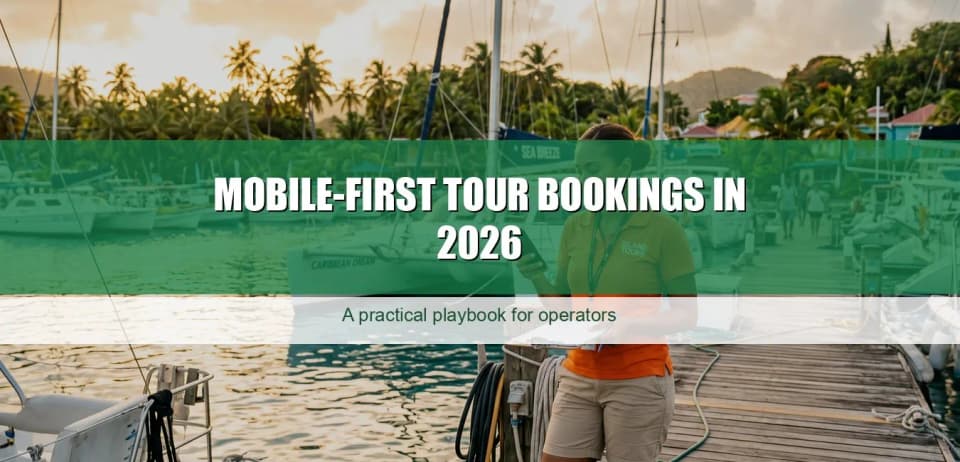
When I was working Eagle Tours as a young guy, the hotel concierges were the mobile booking system. A guest at the pool would flag down the activity desk, the concierge would call my parents' office to check availability, and if the phone rang through to voicemail they shrugged and went back to their cocktail. Tour gone. That whole window was about two minutes.
That same pressure exists now. It's just moved to a phone screen. The guest at the beach isn't talking to a concierge anymore - they're tapping through your booking form with sunscreen on their fingers, terrible Wi-Fi, and two competitor tabs already open.
I'd say 70% or more of the bookings we see on Junglebee happen on mobile. A lot of them while the guest is already in destination - on the beach, at the resort bar, walking through Philipsburg. They've decided they want to do something. They found you. And if your form has more than three screens, they bounce. Not because they changed their mind. Because you made it too much work at exactly the wrong moment.
The booking form is the product
Most operators think the product is the tour. The snorkel trip, the sunset cruise, the fishing charter. And that's the experience they're selling. But before the guest ever steps on the boat, the only thing they've interacted with is your booking flow. That's your product, as far as they're concerned.
A booking form that loads slowly, requires account creation, or buries the price two screens deep is a product failure. It doesn't matter how beautiful your catamaran is. The guest never gets there.
Arival tracked the shift: mobile booking for activity travelers went from 11% in 2019 to 28% in 2023. That's already your majority channel when you count last-minute in-destination bookers. And the broader demand is there - UN Tourism reported about 1.4 billion international tourist arrivals in 2024, roughly 99% of pre-pandemic levels, with another 11% growth over 2023. People are traveling. The question is whether they can book you in under two minutes on a phone.
What three screens actually costs you
The typical problem isn't one big thing. It's four small things stacked on top of each other:
- A slow product page with a video hero or a full-width image carousel that takes eight seconds to load on cellular.
- A calendar widget that requires pinching and zooming because it was designed for a 1200-pixel screen.
- An account creation step somewhere in the middle of checkout that kills the momentum completely.
- A surprise fee at the end - marine park user fee, fuel surcharge, something that wasn't on the product page - that triggers hesitation right before the card number.
Each of those alone isn't fatal. All four together and you've built a checkout a motivated guest can't finish in the two minutes of attention you actually have. Online booking for tours and activities passed 50% in 2023, per Arival. Those bookings go to operators with clean mobile flows.
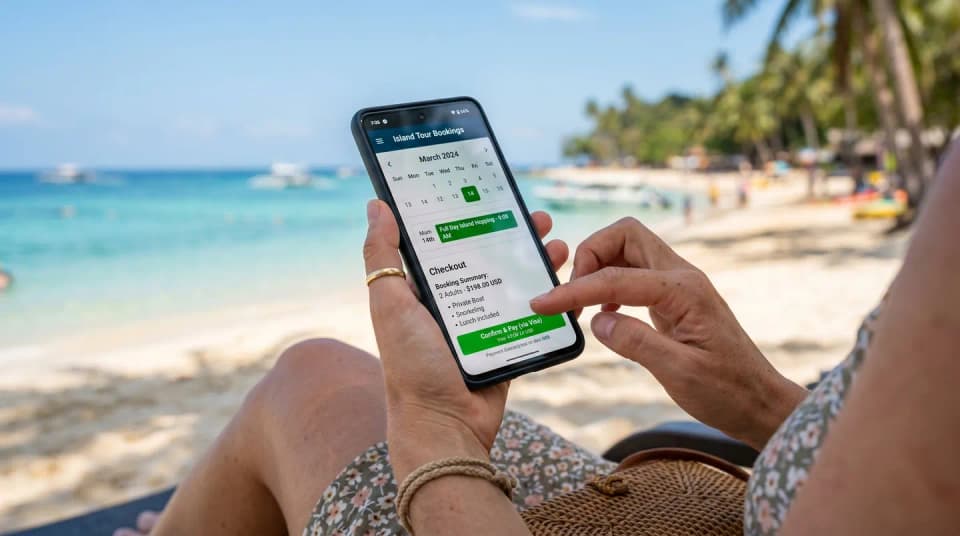
What a clean mobile booking flow actually looks like
Fast beats fancy. That's the whole rule. But let me make it more specific.
Screen one: your tour, the price, the date picker, and the ticket count. That's it. No life story, no seventeen photos, no trip advisor widget loading in the background.
Screen two: guest details. Name, email, phone. Maybe a special request field. Do not ask for date of birth, home address, or an account password at this step. That's for health clubs, not charter operators.
Screen three: payment and confirm. Show the total clearly. Show what's included. Charge the card. Send the confirmation. Done.
Three screens. If your system requires more, ask yourself why each extra step exists - and whether the guest cares about it, or only you do.
The confirmation matters more than most operators realize. If it doesn't answer where to meet, what time, what to bring, where to park, and how to reach you - you've created a customer service job for yourself. Multiply that by a full season and it's a lot of WhatsApp messages that didn't need to exist.
Mobile ops: what happens after the booking
The front-end checkout gets all the attention, but the operations side matters just as much. A guest books on mobile expecting speed from you too.
- Instant confirmation means automated. Not "we'll confirm within 24 hours." That message was acceptable in 2012. Now it means the guest is already comparing you to someone who confirmed immediately.
- Automated reminders with the meeting point and contact number, sent 24 hours before and again a few hours out. A lot of "no-shows" are not flaky guests - they're guests with unclear instructions who went somewhere easier.
- One-click reschedule rules for weather. Christmas Winds run December through February down here. If rescheduling a blown-out morning run requires three emails between you and the guest, that's three opportunities for a chargeback instead of a rebooking.
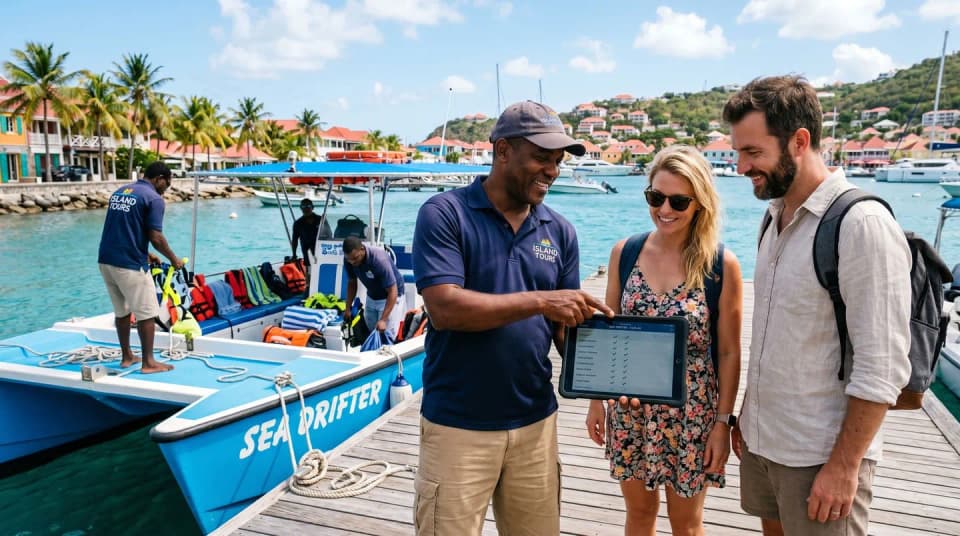
- A clean crew list your captain can read. Not a screenshot of a Slack thread. An actual list: name, headcount, paid, meeting point. On a phone. Before the boat leaves the dock.
We built the Junglebee booking system for charters around this flow - three-step mobile checkout, instant confirmations, automated reminders, and a crew-facing guest list that works on a phone before the boat leaves the dock. The operators we built with told us they were losing bookings and burning time on exactly these things.
The 60-minute audit you can do this afternoon
You don't need a developer or a full website rebuild. You need to actually use your own booking flow on your phone, on mobile data, not the marina Wi-Fi.
- Time yourself from landing to payment confirmation. If it's more than 90 seconds for a guest who knows what they want, something needs to change.
- Count the screens. If it's more than three before the card gets charged, audit every extra step.
- Read your confirmation email. Does it answer where, when, what to bring, where to park, and how to reach you? If you'd have questions after reading it, your guests will too.
- Click your Instagram link and your Google Maps link. Do they land on the right page fast? Or do they redirect to a homepage that has nothing to do with what the guest just saw?
- Find the manual step you can't get rid of. There's usually one - a confirmation you have to send personally, a question you answer by hand every time. That's the bottleneck. Fix that before anything else.
If the bottleneck is the booking system itself - if it just wasn't built for mobile or for the way guests actually behave - it might be worth looking at what else is out there. The pricing page is public, which I mention because not every booking system makes that easy to find.
Book like you're already at the beach
Your mobile booking form is the concierge now. The guest is at the beach - maybe literally. They're on their phone, already decided, just trying to hand you money. If your form makes that hard, you're not losing the booking because the tour wasn't good enough. You're losing it because the two minutes ran out.
Three screens. Fast load. A confirmation they never have to follow up on. That's the whole job - and it's a lot easier to fix than most operators think.
Booking page, card payments, one calendar for your website, booking page and desk. 4% per card payment, no monthly fee.