Junglebee
How Group Pricing Sells More Tours
People are starting to gather again and travel as a group of family or friends - here's how to create a group offer.
 Michael RouveureFounder, Junglebee · · updated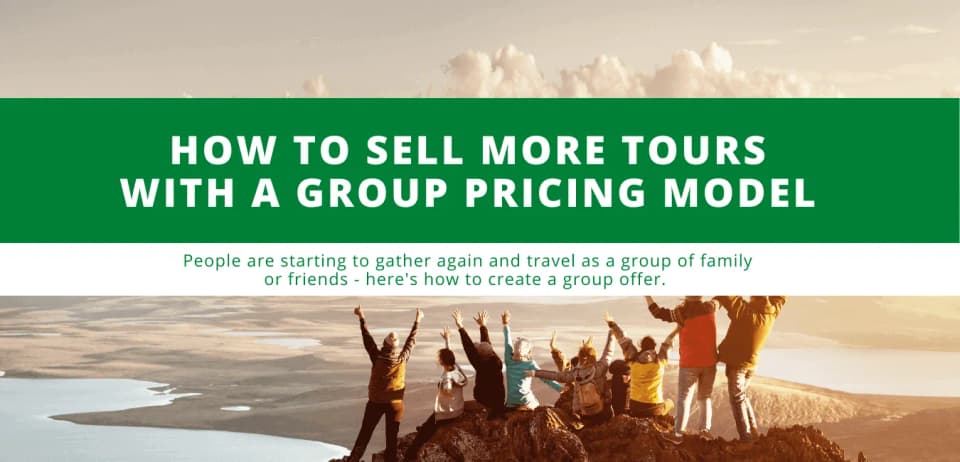
How do you price a group booking without spending an hour on every quote?
That question comes up constantly. I'd say half the operators I talk to are still handling group pricing the same way they did ten years ago: a group inquiry comes in, someone on the team figures out how many people, works out some discount in their head, types up a custom quote, sends it, then waits. Sometimes the group books. Often they don't. The follow-up lands three days later and by then the group is already on someone else's boat.
There's a better way to do it. And it doesn't involve getting creative on every single inquiry.
Why manual group quoting loses you more bookings than you think
I know an operator -- good boats, reliable crew -- who quoted groups manually for years. His reasoning was that every group is different. Some want a sunset run, some want a full-day. He didn't want to lock himself into a structure that didn't fit the situation.
I get the logic. But here's what was actually happening: he was closing maybe two out of every ten group inquiries. People would email, wait two or three days for a quote, and by then they'd either booked somewhere else or given up. A group booking takes more coordination than a solo booking. Add friction to the price conversation on top of that and most of them bail.
He switched to automated tiered pricing. Same rates, same logic -- just built into the system so it applied itself. His group close rate went to around 80% within the first few months. Not because his tours got better. Because the answer came back fast.
That's the whole case for automating group pricing. Not the "perfect" rate every time. A rate in two minutes instead of two days.
How to structure tiered group discounts
The structure I'd recommend -- and the one that works well for most boat operators -- goes like this:
- 1 to 4 guests: full rate, no discount
- 5 to 8 guests: 5% off
- 9 to 12 guests: 10% off
- 13 or more guests: 15% off
A few things worth noting here. First, discounts apply to full boat fills, not piecemeal. If someone books 9 people but you've got 3 other guests already on that run, they don't automatically get the 9-person rate just because their headcount hits the threshold. You're discounting based on what they're bringing to the boat, not how full the boat ends up.
Second, the math still works in your favor as the group gets larger. Say your standard rate is $110 per person. Six guests at full rate is $660. Twelve guests at 10% off is $1,188. You gave up some margin per head and you nearly doubled the revenue on that single departure. Even if you throw in a small perk for the group organizer -- which I'll get to -- you're still well ahead.
The operator who "loses money on discounts" is usually the one who's giving the discount on a half-empty boat. If the discount is what filled the boat, the discount paid for itself.

Build it into the software so it applies itself
This is the part most operators skip. They decide on the tiers, write them down somewhere, and then still quote manually because the discount isn't actually wired into anything. That defeats the purpose.
Group pricing only solves the speed problem if it's automatic. When someone comes to your booking page and enters a headcount of 10, the system should show them $99 per person -- not $110 with a note that says "contact us for group rates." That note is a drop-off point. Every time someone has to email you to find out the real price, a percentage of them just leave.
If you're on Junglebee, this is handled at the booking widget level -- you set the tiers, they apply based on guest count. The customer sees the discount before they check out. No quote request, no back-and-forth, no waiting on you to reply between trips.
The manual quote process made sense when there was no other option. There's another option now. Use it.
Frame the discount as savings for the person doing the organizing
One person in the group does all the work. They research the options, coordinate the headcount, collect money from their friends. That person is doing a real job, and they often feel like they got nothing out of it except a headache.
Frame group pricing as savings that the organizer delivers to their group. Not a discount you're offering -- savings they unlocked. "Book 9 or more and your group saves 10%" puts the organizer in a good position. They're the one who made the deal happen. That's psychologically a completely different thing than "we're giving you a discount."
You can take this one step further with a free organizer perk. For groups of 8 or more, the person who made the booking gets comped. Their spot is free. They've already done the work of filling your boat. Recognizing that with a concrete benefit costs you one seat on a run you might not have filled otherwise, and it gives the organizer a reason to choose you over a competitor at a similar price.
The edge cases are the exception, not the rule
The most common pushback I hear is: "Every group is different. Some want a private charter. Some want a custom itinerary. I can't put that on a pricing page."
That's true, and I'm not saying ignore those situations. I'm saying don't let the edge cases be your reason to manually handle the common case. Most group inquiries are straightforward: a set number of guests, a standard tour, a date. That's 80% of what comes in. Build the system for the 80%. Handle the 20% by exception.
If someone wants a full private charter with a custom route, sure -- that's a conversation. But if someone has 11 people who want your snorkel run, they should be able to book that in under five minutes without anyone on your team being involved. The operators who don't automate the common case are losing those bookings to the operators who did. That's not a guess. I've watched it happen.
Price the group, not the inquiry
Group pricing isn't about discounting. It's about converting inquiries into bookings at the speed that today's customers expect. The tiers give you a structure. The software makes it automatic. The organizer framing gives it a psychological edge. The free perk seals it for the close calls.
The operator I mentioned at the start -- the one who went from closing 2 in 10 to 8 in 10 -- didn't change his tours. He didn't lower his prices. He just stopped making people wait three days for a number they could have gotten in thirty seconds. You can do the same thing before the end of this week.
Set the tiers. Wire them into your booking system. Let the software do the quoting. Handle the edge cases when they actually show up.
Booking page, card payments, one calendar for your website, booking page and desk. 4% per card payment, no monthly fee.