Junglebee
How to Position Your Tour for Luxury Guests
Providing five-star service from start to finish is just one of the keys to creating a luxury experience.
 Michael RouveureFounder, Junglebee · · updated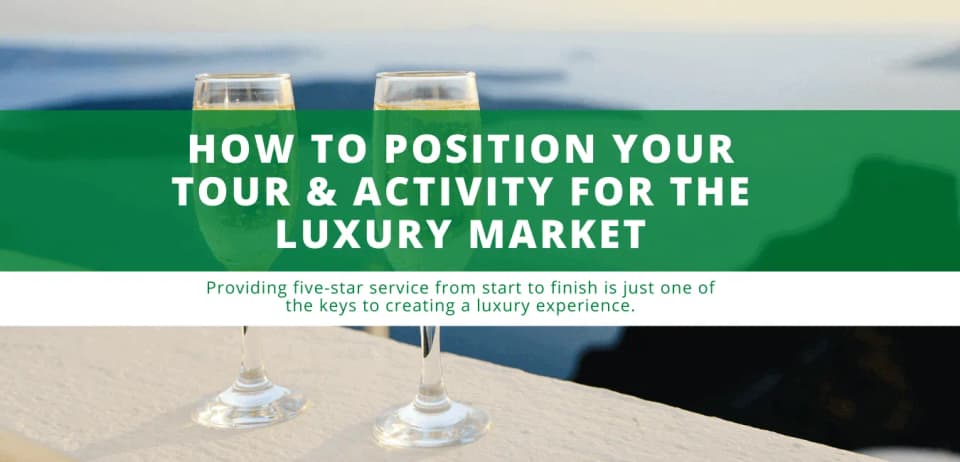
The guest boarded, looked down at the cockpit, and before anyone said a word he pulled out his wallet.
This was a half-day charter out of Simpson Bay through Eagle Tours. The captain had iced a bottle of French champagne that morning - not in a cooler full of Presidente, in its own bucket, stems already on the table. The guest didn't ask for it. Nobody had promised it. It was just there. By the end of the trip the captain got a $1,500 tip in cash. On a half-day.
I've thought about that story a lot. The boat wasn't bigger than any other boat. The route wasn't secret. The captain didn't perform tricks. He just removed one small piece of friction the guest didn't even know was friction - the moment of arrival where most guests stand there wondering what happens next.
That's what luxury actually is. Not velvet ropes or gold-plated anything. Frictionless.
What luxury guests are actually paying for
Luxury travelers pay 3x to 5x the going rate for a charter. Most operators assume they're paying for the nicest boat, the best champagne, the fanciest lunch spread. Those things matter, but they're secondary.
What they're actually paying for is the removal of every awkward moment, every small decision, every second where they have to think about logistics. They've done that all week at work. They're paying you so they don't have to do it on holiday.
The luxury guest who has a bad experience rarely complains about boat speed or fish size. They complain that they waited at a marina with no shade, that check-in felt like a car rental desk, that someone handed them a paper form with a ballpoint pen attached by a rubber band. Every one of those moments is a tell. It says: this operator hasn't thought about who I am.
Five things that separate a real luxury charter from a nice one
I'd say most "luxury" tour operators down here are mid-tier tours in nicer packaging. Better photos, a classier font, maybe a bottle of something chilled. But the experience still has all the friction - shared boats, dock meetups, cash at the end. That's not luxury. That's a sprinkled-sugar makeover.
Here's what actually moves the needle:
- Private or charter only - no shared boats. Luxury guests do not want to sit next to strangers on a catamaran run. Full stop. If you mix private and shared departures under the same "luxury" umbrella, your luxury guests will notice eventually, and they will not come back.
- Pickup at the villa or the yacht, not "meet at the dock." The dock is a logistics problem for the guest. A tender or a driver to their villa at 9am is not. One of those reads as hospitality. The other reads as a field trip departure.
- Champagne on arrival - in real glassware. This is the champagne-in-the-bucket moment. It doesn't have to be French champagne. A premium local rum, a proper whisky, a fresh-pressed juice from the French side market. What it cannot be is a warm can of something handed across the transom. The glassware is not optional. Plastic cups are a vibe killer.
- A photographer or drone shot included. They want the post. They're going to photograph this day regardless - the question is whether you help them get a shot they can actually use. A crew member who knows how to shoot, or a drone sequence over Tintamarre, is worth more to that guest than an extra stop.
- A customizable route - they pick the beaches. Fixed itineraries are for group tours. The luxury guest wants to feel like the boat goes where they want it to go. Even if 80% of your routes are the same, the conversation where you ask them what they want matters. It changes the whole texture of the trip.
The money thing - get this right or nothing else matters
I saw an operator lose a repeat client over this. The trip was perfect - private charter, good route, good food. And at the end the captain handed the guests a printed receipt and asked them to sign it on the dock.
The guest had not thought about money for six hours. They'd been drinking champagne and swimming at Pinel Island. And now they were standing in the sun squinting at a piece of paper with tax lines on it, making a financial transaction in front of their family.
The rule is simple: the operator never asks for money in person. Card on file before the trip starts, balance clears automatically that morning. If there's a tip, it's either pre-added with an opt-out or arrives in an envelope - which is a gift, not a transaction. The whole experience should say: do not make me think about money.
If your system isn't built for that, fix the system before you fix the champagne. We built Junglebee to handle exactly this - card on file, automatic charges, nothing that looks like accounting at the dock.
The channels and the clients that actually feed the luxury market
Luxury guests rarely find you on Google. They find you through a concierge who trusts you, a villa manager in Terres Basses who has your number saved, or a sailing neighbor who mentioned you at dinner. That referral network is the whole game at the top end.
Get in front of the right hotel activity desks. Have a clean booking flow so that when a concierge puts together a last-minute charter for a villa rental, it takes three minutes, not a phone call and two emails.
Publications like Travel + Leisure, Elite Traveler, and Conde Nast Traveler have real reach with this audience - but those placements work best when you already have the product dialed in. The worst thing you can do is drive a high-end traveler to an experience that still has plastic cups and dock-based check-in.
What your website and booking page actually say about you
A luxury guest's first impression of you is almost always your website. Not your boat. Your site.
The visuals buy you five seconds. After that, the guest wants to know what makes you different and how to book. Both need to be easy to find. Real photography of real guests on your real boat - not stock images of anonymous people on a generic catamaran. Luxury guests have good eyes. They'll know.
The booking flow is part of the product. Confusing forms, unclear pricing, a process that asks for the same information twice - all friction. And friction is what they're paying you to remove.
One rule that covers everything
The reason that $1,500 tip happened wasn't champagne. The champagne was just the symbol. What the guest was tipping for was the feeling that someone had anticipated exactly what he needed before he knew he needed it.
That's the one rule. At every step, ask: did I make the guest do anything he shouldn't have to do? Wait? Fill out a form? Sign a receipt in the sun? Ask where to put his bag?
If the answer is yes to any of those, you're in the nice-boat business. Which is fine. But it's not the same thing as luxury.
Strip out every moment that makes a guest feel like a customer. That's the whole playbook.
Booking page, card payments, one calendar for your website, booking page and desk. 4% per card payment, no monthly fee.