Junglebee
How to market a tour company
A guide to the four channels that actually move seats for a small tour company: concierge, Google Business Profile, direct bookings, and OTAs.
 Michael RouveureFounder, Junglebee ·
The best marketing channel for a small tour company isn't a channel. It's a hotel concierge who has your brochure at the front desk and your cell number in her phone.
I know that's an unpopular thing to say in 2026, when so much marketing advice for tour companies talks about ad spend, funnels, and which platform to boost your posts on. But I grew up doing this. Long before any software, before SXM Deals, I was a captain running the afternoon snorkel run for my parents' company, Eagle Tours, out of St. Martin. And the seats that filled up most reliably weren't the ones from some clever campaign. They were the ones a concierge in Simpson Bay sent us because she trusted the boat and she trusted us to look after her guest.
So here's how I'd actually market a small tour operation, in the order I'd spend my time on it. Not the order a marketing agency would sell you.
Start with the handshake, because it still beats every ad
The offline relationship is the most underrated marketing move in this whole business, and it's the one too many online guides underplay because you can't buy it with a credit card.
When I was running boats, the concierge circuit was the entire game. You'd drive the Simpson Bay hotels in the morning, drop off fresh printed brochures, make sure the front desk had a stack, and you'd actually learn the names of the people working the activity desk. Same with the cruise ship greeters. On a cruise ship day, the person standing at the end of the pier with a clipboard could send you a full boat or send it to the operator next door. That was a relationship, built over months, not a transaction.
If you're starting out, do this first:
- Walk into the hotels near your dock. Bring a printed one-pager with photos, times, and a price. Front desks lose digital things. They keep paper.
- Give them a real reason to send guests to you. Reliability, a clean boat, a captain who shows up on time. A concierge is putting her own reputation on the line every time she recommends you.
- Make it stupidly easy to book you. A number that gets answered. A confirmation that comes back in minutes, not the next morning. If a concierge sends a guest and can't get a fast yes, she stops sending guests.
That last point is the one I lost money on for years, so I don't say it lightly.
Fix your Google Business Profile before you spend a dollar on ads
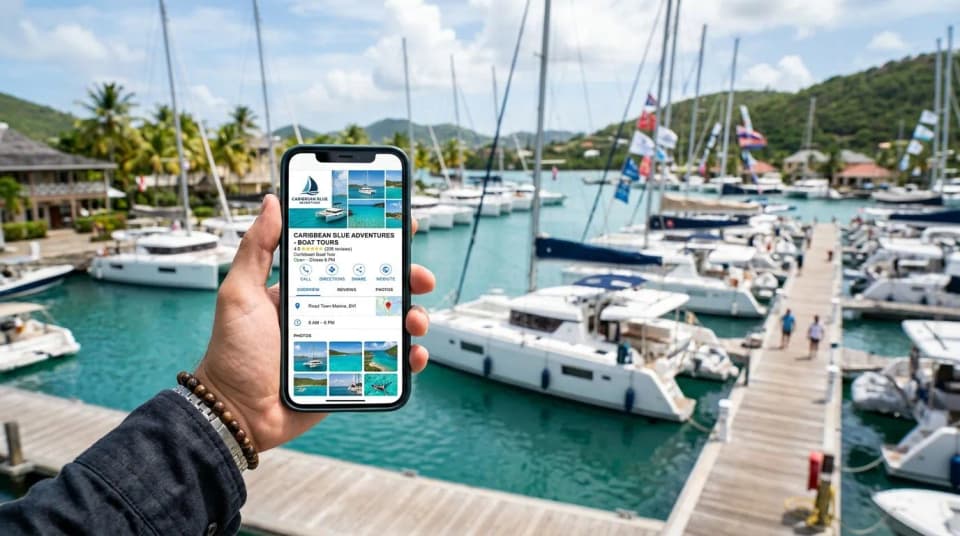
When a guest lands and pulls out their phone, they type your name or they type "boat tour" and your island. What shows up is your Google Business Profile. That listing may be doing more marketing for you than any post you'll ever write, and too many operators treat it like an afterthought.
Three things move the needle here, and they're all free:
- Photos, real ones. The boat, the water, guests actually smiling on your trip. Not a stock sunset. People book what they can picture themselves doing.
- Reviews, asked for on the dock. The best time to get a review is the moment a guest steps off the boat still buzzing. Ask them right there. Don't wait to email them a week later when they're back in the office.
- A call-to-action that goes somewhere. A phone number that rings a human, or a booking link that actually books. A dead "call for pricing" button is a guest lost to the operator whose button worked.
And keep it current. If your hours changed for low season, change them on the profile. A guest who drives to a closed dock can leave a one-star review that costs you future bookings.
Put your prices on your own site, in plain view
This is where I get opinionated, so brace yourself. If your website says "contact us for pricing," you are marketing against yourself.
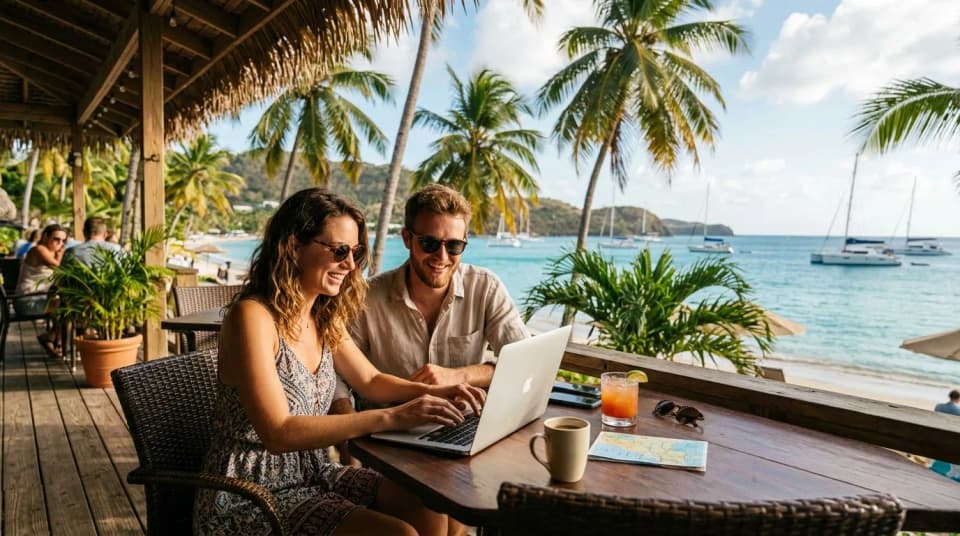
I've watched operators hide their prices because they're scared a competitor will undercut them, or because they want to "get the guest on the phone first." Both instincts are wrong. The guest researching a snorkel trip at 11pm from their hotel bed is not going to email you and wait. They're going to book the operator who showed them a price and a "book now" button, took their deposit, and let them go to sleep.
A direct-book site with real prices is the highest-margin marketing you own, because there's no OTA commission between you and the money. The reason so many operators never do it is that taking a card payment in the Caribbean is genuinely hard. Stripe is still unavailable to many Caribbean operators, and PayPal availability and withdrawal rules vary by market. We built Junglebee partly to solve exactly that, so an operator can show a price, take a deposit, and have the money land in their own local bank. But whatever tool you use, the rule holds: show the price, take the booking, on your own site.
Use the OTAs to get found, not to run your business
Tripadvisor's Things to Do pages, Viator, GetYourGuide. These are useful, and I'm not going to tell you to skip them. A guest who's never heard of your island searches "things to do" and you show up. Discovery is worth paying a commission for when it brings you someone who would never have found you otherwise.
But they are a discovery channel, not your storefront. Here's the trap: an operator gets comfortable letting an OTA fill the boat, commissions quietly take a meaningful cut off every seat, and one day they realize the OTA owns the guest list, not them. Raise your price and you're dependent on a platform whose ranking and promoted-placement systems you don't control.
My rule: let the OTAs bring you strangers. Then do everything in your power to turn that stranger into a direct guest next time. Put a little card in their hand on the boat. Ask for the review. Get them to your own site for the repeat trip. The OTA earned its cut on the first booking. It doesn't get to own the guest forever.
What I'd do this week
If you only did a handful of things over the next seven days, do these. Print one good brochure and walk it into the five closest hotels to your dock. Open your Google Business Profile and add ten real photos and ask your next ten guests for a review before they leave the dock. Put your actual prices and a working booking button on your own website. And go look at what percentage of your bookings came through an OTA last month, because if it's most of them, you don't have a marketing problem, you have an ownership problem.
None of this is clever. It's just the order that works, and it's the order I learned handing brochures to a concierge in Simpson Bay who could fill my boat with one phone call. Marketing a tour company is mostly earning the right to be recommended, then making it easy to say yes. Everything else is decoration.
Booking page, card payments, one calendar for your website, booking page and desk. 4% per card payment, no monthly fee.