Junglebee
Charter booking software: what actually has to work
Most charter businesses don't have a booking problem - they have a decision-latency problem. Here is what your booking software has to do on the days that matter.
 Michael RouveureFounder, Junglebee ·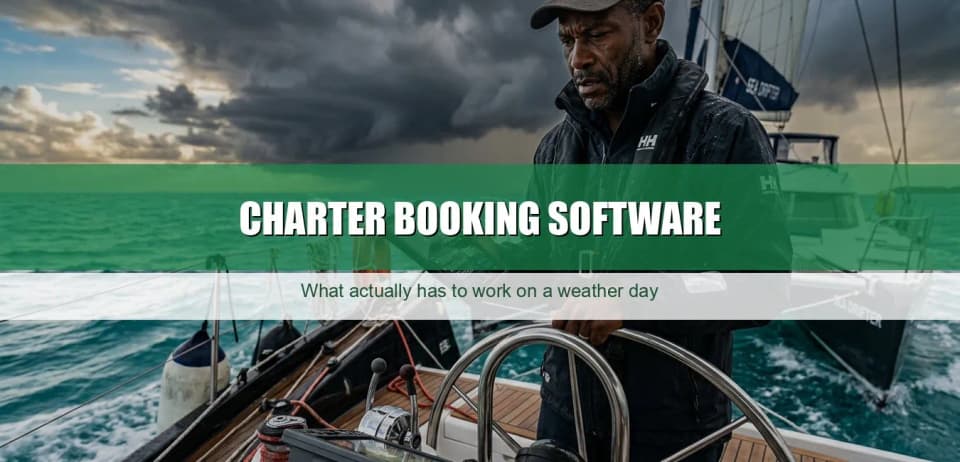
I once lost a charter because it took two days to say yes.
This was back when I was running SXM Deals, the site I built to book tours and charters across St. Martin. A group came in wanting a private charter. A big one, the kind that pays your week. I didn't want to run their card before the operator confirmed he had the boat and the crew free, because if he didn't, I'd be refunding a small fortune. So I emailed him and asked him to confirm. Then I waited.
Two days. Not two minutes. Two days. By the time he wrote back, the guests had booked someone else and were already out on the water. The money was sitting in my hands the whole time, ready to go. The booking was real. The only thing that failed was the speed of the answer.
That's the part most operators get wrong about booking software. You don't have a booking problem. You have a decision-latency problem. The software either protects your speed-to-confirm or it kills it. And everything below is about telling the difference.
Charter booking is not tour booking
A lot of software calls itself a booking system and means tour booking. Fixed departures. Set seats. A 10am snorkel run with 24 spots, sell them and go. The software for that is mature.
Charters don't work like that. A charter is one boat, one party, one negotiation. The price moves with the group size, the hours, the route, whether they want lunch on Pinel or just a beach drop at Tintamarre. The deposit is real money, not a $20 seat hold. The whole thing is a back-and-forth before anyone says yes.
So when you test a system on charter work, the question isn't "can it take a booking." It's "how fast can it turn an inquiry into a confirmed, paid charter without me typing six emails." If the answer is slow, it doesn't matter how pretty the calendar is. You'll lose the ones that pay the most, because the big charters are exactly the ones people shop around.
The five things your software has to do on a real weather day
Anyone can take a booking on a flat-calm Tuesday. The software earns its money on the bad day. Christmas Winds are up, a front is rolling through, and you've got three charters that can't run as planned. That's where weaker systems quietly start to show their limits.
- Move a charter without breaking it. You need to reschedule a confirmed, paid trip to another day in a couple of clicks and have the deposit follow it. Not cancel and rebuild. Not three emails. Move it.
- Hold the money instead of refunding it. On a blown-out day you want to issue credit, not cash back. A system that only knows "refund" trains your guests to walk away with their deposit the second the wind picks up.
- Know which boat and which captain. If you shuffle trips, the system has to know that the same captain can't be on two boats at 2pm. Otherwise you'll double-book your own crew and find out at the dock.
- Tell the guest before you have to call them. Automated comms on a reschedule saves you the worst hour of any weather day, which is calling twelve guests one at a time while you should be securing boats.
- Protect availability across every channel at once. If a guest pays on an OTA the same minute another pays on your widget, one of them has to be refused. On a cruise ship day, a double-booked boat is two angry parties in the parking lot.
Notice none of those are about marketing. In my experience, many charter operations don't fail for lack of leads. They struggle because the owner is buried in manual confirmation and reschedules, and guests lose confidence somewhere in the back-and-forth. The booking software is supposed to carry that load. When it doesn't, the operator ends up carrying it manually.
Deposits, balances, and the money gap most software ignores
Charters live on deposits. You take a piece up front to hold the date, the balance comes later, sometimes the day of. Some booking systems still make this feel like an afterthought. If the workflow was designed around full-payment seat sales, the deposit and balance chase gets bolted onto your day.
Watch for the gaps. Can the system charge a deposit now and the balance automatically later, or do you have to chase the guest with a card machine on the dock? When you reschedule, does the deposit move cleanly or does your accounting turn into a puzzle? When a refund or a credit happens, can you actually see what it did to that trip's numbers?
Then there's the money itself. I've seen serious Caribbean operators take card payments through software that pushed them toward payout setups outside their own island, then wire the money back home. Usually because the software came with one payment rail in the box and they bent the whole business around it. I'll be honest, it always made me uncomfortable, because payments, tax, and local banking should be cleaner than that. We built JB Pay so an operator on Junglebee can talk through deposits, balances, currency, and payout setup before they commit to a workflow. Your booking software shouldn't be deciding which continent your deposit visits first.
What I would actually test before signing anything
Skip the comparison sites. Pick two systems and run them with real work. Build one actual charter in each, deposit and balance and weather policy included, then push a week of live inquiries through both. You'll learn more in seven days than in seven demos.
Count a few things. How fast did an inquiry become a confirmed, paid charter. How many clicks to move a trip for weather and keep the deposit attached. How long a refund or a credit took you. Whether a returning guest had to re-type their card.
Then call support and ask one question only an island operator would ask. A force-majeure cancellation with the wind at 30 knots. Agent net rates for a hotel activity desk. Marine park user fees on a charter to St. Barts. The answer tells you whether the people who built it have stood on a dock, or just sold to people who do. And if a vendor will walk you through every feature but won't put their fees on a public page, that opacity is a cost too, before you've paid a cent.

Build the business that answers in two minutes
The captain who lost me that charter in 2012 wasn't bad at his job. He was a great captain. His back office was just him, and he was elbow-deep in salt water for two days while my guests booked someone else.
That's the whole thing. The right charter booking software answers while you're out running a trip. The deposit charged the moment a guest commits. The reschedule handled before you've untied the lines. The payment path understood before the trip runs. Build the business that answers in two minutes, not two days. I learned that one the expensive way so you don't have to.
Booking page, card payments, one calendar for your website, booking page and desk. 4% per card payment, no monthly fee.