Junglebee
4 Tips for Creating Unique Boat Tours
A unique angle will help you stay competitive in the boat tour market - what's yours?
 Michael RouveureFounder, Junglebee · · updated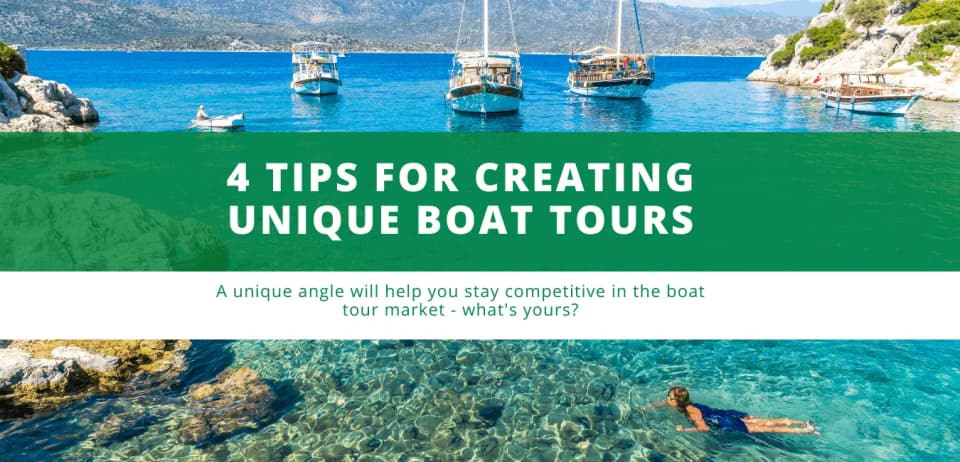
A guest left a review for Eagle Tours that I still think about. She didn't mention the boat. Didn't mention the crew. Didn't say the food was good or the music was fun. She wrote: "We swam with Jupiter. He came right up to us. I have never been that close to a turtle in my life."
Jupiter is a hawksbill who lives on the reef off Tintamarre. The crew named him. They know where he sleeps. That review - that specific review - went up the same month Eagle Tours added the turtle stop to the afternoon run. Bookings jumped. Not because the tour got longer. Not because they added anything expensive. Because there was suddenly a story the guest could tell that no other tour on the island could give them.
That's what a unique boat tour actually is. Not a longer list of things. One moment you cannot get anywhere else.
Name a specific moment - not a category
Look at how 30 boat tours on the same island describe themselves. Almost all of them say some version of: "snorkel, swim, lunch, scenic cruise." That is not a tour description. That is a category description. A guest reading it cannot picture anything. And if they can't picture it, they won't book it.
The operators who stand out name the moment. Not "snorkeling included" - "snorkel with wild dolphins at Kizimkazi." Not "explore sea caves" - "swim through the bat cave at slack tide, when the light comes through." Not "visit an underwater attraction" - "stop at the statue garden twelve feet down, where the coral has been growing for fifteen years."
The moment has to be specific enough that the guest thinks: I cannot get that on any other boat. That specificity is the product. The rest - the boat, the drinks, the lunch - is the packaging.
Go back to your tour description right now. If you could replace the tour name with a competitor's name and have it still be accurate, the description isn't doing its job. Find the one thing on your route that nobody else has and put that in the first sentence.
Pick one thing to be known for and commit to it
I know an operator who decided a few years back that his thing was marine knowledge. His captain knew the name of every fish species on the reef. Not the common name - the actual Latin name and its diet and its behavior. Guests who didn't care about fish still talked about it, because the specificity was unusual. "Our captain knew every fish by name." That became the story.
He didn't add a second boat or change his pricing. He just committed so hard to one angle that it became his identity.
Most operators go the other direction. They try to differentiate by adding: a second snorkel stop, a third drink option, a guide who speaks four languages, a fancy lunch, equipment upgrades. I've watched this happen and I've watched the reviews get worse, not better. More features create more things that can go wrong, and a guest who got five out of seven promised things leaves a three-star review. A guest who got the one thing that was truly promised leaves five stars and posts the video.
You do not win by adding. You win by committing. Pick one angle and be the undisputed best at it. Let the operator across the bay be everything to everyone. You'll own the guests who care about your thing, and they will find you.
One signature food or drink moment beats fifty generic options
The food on most boat tours is fine. Generic. Interchangeable. Chips, sandwich wraps, a cooler of beer that ran warm by noon. It's not bad. It's just not memorable.
What is memorable: the rum punch with fresh lime squeezed from a fruit one of the crew picked that morning. The lobster taco made by the captain's mother and packed at 5am. The local hot sauce the crew brings every single trip because that's what we do.
You don't need a full catering operation. You need one thing. One item that guests mention by name in reviews, photograph before they eat it, and ask about when they're booking again. A single signature is worth fifty interchangeable items. Fifty items gives guests nothing to say except "the food was good." One signature item gives them a sentence: "they make this rum punch with fresh coconut water and the captain cuts the lime right there on the boat."
Think about what your crew already makes or brings that people react to. That's usually the starting point. Then systematize it so it happens every trip, not just when someone remembers to bring it.
The off-script moment is what guests post about
You can't script a pod of dolphins passing thirty feet off the starboard. You can train your crew to act on it.
There's a real difference between tours where the crew follows the route and tours where the crew is watching for moments. A guest who gets pulled from a snorkel stop early because the schedule says it's time to move doesn't write a memorable review. A guest whose crew changed the route mid-trip because they spotted a manta ray - and jumped in the water with them - has a story they'll tell for years.
This isn't about being unprofessional or ignoring safety. It's about giving your crew permission - actual explicit permission - to make a call when something worth doing appears. The underwater statue garden will be there next Tuesday. The juvenile whale shark that just surfaced won't. A crew who knows they are authorized to respond to that moment will respond. A crew who only knows the script won't.
Brief it before every trip: "If you see something, tell me. We'll make the call together." That briefing costs nothing. The review it generates is worth more than any feature you could add to the listing.
A unique tour is not a tour with more features
Most operators design tours that are safe, predictable, and forgettable. Not because they're lazy. Because they're afraid that if they cut something, a guest will notice and complain. So they keep adding. New stop. New drink. New activity. And the tour becomes a sampler platter instead of a meal.
The tour that gets recommended - that gets shared on Instagram, that guests send to their friends with "you have to do this" - is the tour built around one irreducible moment. The moment they name in the review. The moment they couldn't have gotten anywhere else on the island.
Jupiter the turtle. The rum punch with the fresh lime. The captain who jumped in the water when the dolphins appeared. That's your product. Everything else is the boat ride to get there.
If you are still figuring out the booking side of a tour operation - how to take deposits, handle last-minute cancellations, get your calendar in front of the hotel activity desks - that's a separate problem and we built Junglebee to handle it. But no booking system in the world fills the seats for a tour that guests can't remember.
Booking page, card payments, one calendar for your website, booking page and desk. 4% per card payment, no monthly fee.