

April 17, 2026
A few years back, when I was still running SXM Deals, I had a guest from a cruise ship trying to confirm a catamaran charter. I'd sent her an email. Long, properly formatted, all the details. She never opened it. She eventually found me on WhatsApp and asked if she was actually booked. She'd been sitting in the cruise terminal for 40 minutes wondering.
In the Caribbean, people don't live in their email. They live in WhatsApp, in text messages, on their phones. The confirmation I was proud of - headers, terms, map attachment - was going into a folder nobody was checking.
No-shows and last-minute chaos almost always trace back to a communication gap, not a guest problem. The guest wanted to show up. They just didn't know where, or forgot, or got confused by a wall of text that read like a rental car contract.
Three SMS messages fix most of that. Here's how they work.
Email is not dead. But for day-of tour logistics, it's the wrong tool. Your guest booked a snorkel trip while sitting on a beach bar in Philipsburg. They're not going back to their laptop to find your confirmation. They're going to read whatever shows up on their phone.
SMS open rates average 98%, and 90% of messages get read within three minutes of delivery. Email open rates for travel bookings are something like 20-30% on a good day. That gap matters when you're trying to prevent a no-show on Saturday morning.
And here's the thing I've noticed specifically about Caribbean guests: the WhatsApp culture down here means people are already conditioned to short, direct messages on their phones. A well-written SMS from you fits right into that. A formatted HTML email with an attachment does not.
Stop writing your confirmation like a legal document. Write it like the captain talking to a guest. That's the whole principle.
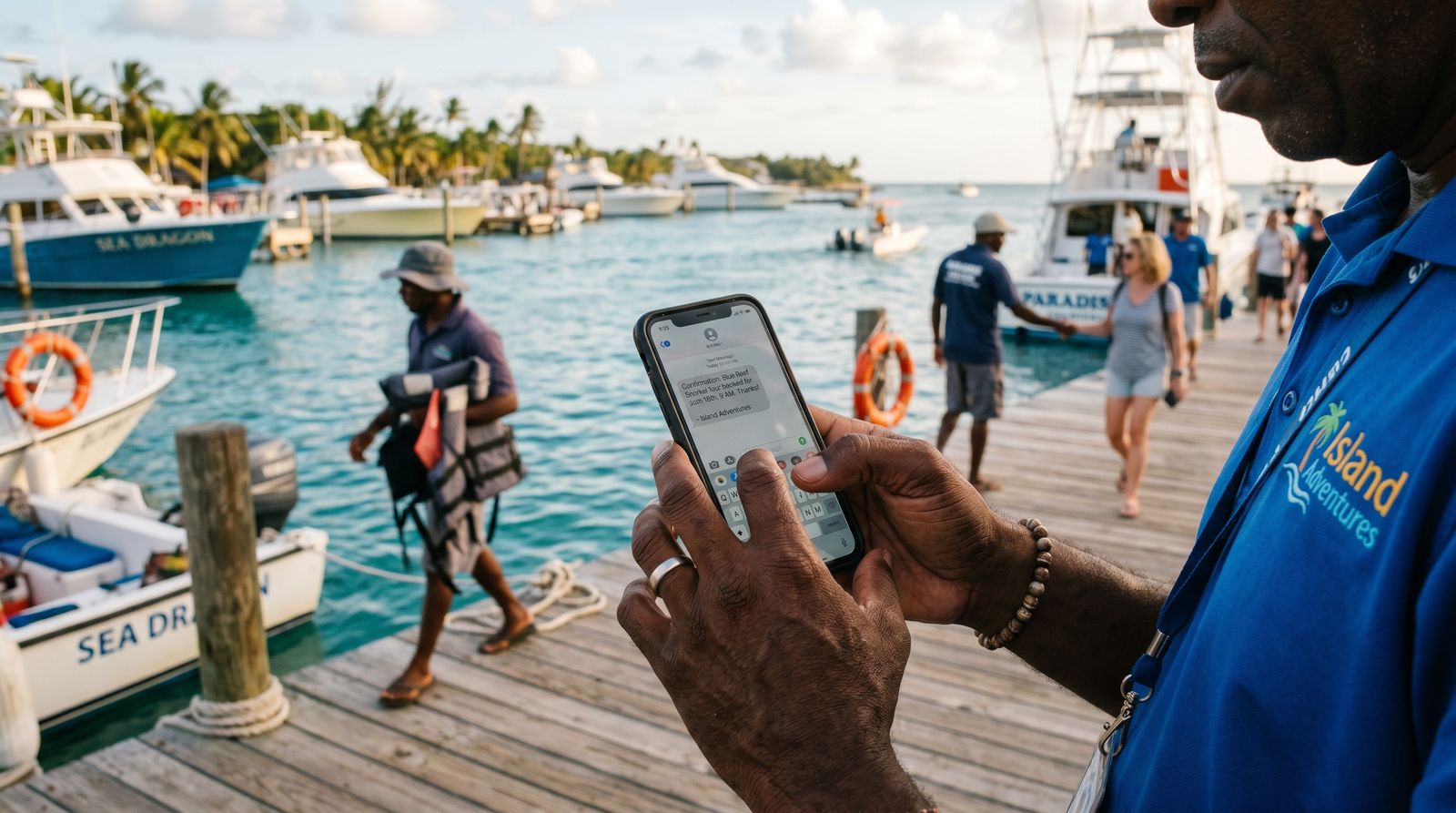
This one goes out the second the booking is confirmed. Not an hour later. Not when you get back to the marina. Immediately. Because the guest's phone is in their hand right now, and this is the exact moment they're paying attention.
The goal is simple: remove uncertainty. A guest who knows the date, the time, the exact spot, and what to bring doesn't email you with follow-up questions. They show up.
Keep it under 320 characters. One goal. No fine print.
Example: "You're booked for the Sunset Cruise - Sat 5:00pm. Meet at Bobby's Marina (map link). Arrive 20 min early. Bring sunscreen and a towel. Reply HELP if you need anything."
That's it. Name of the tour, date and time, exact meeting point with a link, what to bring, and a door open for questions. Nothing more. The temptation is to add everything - the cancellation policy, the waiver link, the parking instructions. Resist it. That's what messages 2 and 3 are for.
This one does two things. It keeps your guests focused, and it gives you early warning if someone needs to bail.
If a guest is going to cancel or reschedule, you want to know at the 24-hour mark, not at 9am on the day of. That window is the difference between reselling the spot and leaving it empty. I've seen operators lose three or four spots on a sold-out run because nobody knew someone had bailed until the boat was leaving the dock.
The message should include a weather note if relevant (Christmas Winds season, for example), a simple way to reschedule or cancel, and a reply to confirm they're coming.
Example: "Reminder: Sunset Cruise is tomorrow at 5:00pm. Need to reschedule? Use this link (manage booking link). Reply YES to confirm you're still coming. See you tomorrow."
The YES reply is worth more than people think. It's not just a confirmation - it's a psychological commitment. Guests who've explicitly said "yes, I'm coming" show up at a higher rate than guests who got a reminder and ignored it.
This is the one that kills the "I went to the wrong marina" problem. And that problem is more common than operators want to admit. Simpson Bay has multiple marinas. Ports with cruise ship docks are a mess on busy days. A guest who was perfectly well-intentioned still ends up at the wrong dock because they remembered the name of the island, not the name of the specific pier.
The morning-of message is pure logistics. Google Maps pin, parking tip, exact check-in instruction, and a phone number if they're running late. One image of the dock sign or the boat doesn't hurt either.
Example: "Today's the day! Check in by 4:40pm at Bobby's Marina (map pin). Parking fills fast - try the lot on the right side of the road. Running late? Call +1-xxx. We can't wait."
Keep the tone warm. This is the last thing a guest reads before they walk down the dock. It sets the mood for the whole experience.
The three-message structure works as-is. A few small upgrades make a noticeable difference:
A study in The Permanente Journal found that an additional text reminder reduced no-show rates by 7-11% compared to a single reminder. That might sound small. On a tour with 12 spots at $150 a head, one extra show-up per week is meaningful money over a season.
That's the honest catch. This system works when it's automatic. The Saturday morning you're prepping the boat and your phone is in your back pocket, you need the flow to run without you remembering to start it. If bookings are coming in through DMs and a WhatsApp thread, that consistency is basically impossible to maintain.
When bookings run through a proper system, the flow fires on its own. That guest on the cruise ship, sitting in the terminal wondering if she was actually booked - she wasn't confused because she was a bad traveler. She was confused because my confirmation gave her no reason to feel confident. It was thorough. It was not warm. It did not sound like a captain talking to a guest he was excited to take out on the water.
We built the Junglebee booking system for operations like this - tours and charters where the crew is on the water, not at a desk, and the reminders need to run whether you're thinking about them or not.
Three texts. Each one with a single job. Written like a person, not a policy document. Run this for two weeks and track your no-show rate. I'd bet you see a difference before the second week is out.


